

How Better Inventory Management Can Help Pizzerias Control Food Costs, Reduce Waste, and Improve Operations
Running a successful pizza restaurant requires more than selling great pizza.
Operators also need to understand what each menu item costs to produce, how much inventory is being used, where waste is occurring, and whether ingredient costs are affecting profitability.
That can be challenging for any restaurant. For pizzerias, it can be even more complicated.
Pizza menus can contain dozens of ingredients, multiple sizes, different topping combinations, specialty pizzas, half-and-half orders, modifiers, sides, and other menu variations. A single order can use ingredients in quantities that change depending on the pizza size and the toppings selected.
That makes pizza restaurant inventory management an important part of controlling food costs and understanding the financial performance of the menu.
An inventory system designed around the way pizzerias actually build and sell food can help operators connect sales activity with ingredient usage, recipe costs, inventory levels, and food cost reporting more effectively.
What Is Pizza Restaurant Inventory Management?
Pizza restaurant inventory management is the process of tracking the ingredients and supplies a pizzeria purchases, stores, prepares, uses, and sells.
It can include everything from cheese, sauce, dough, meats, and vegetables to beverages, packaging, and other products used in restaurant operations.
Effective inventory management helps operators answer questions such as:
- How much of each ingredient do we have?
- How quickly are we using it?
- How much does each menu item cost to produce?
- Are actual ingredient costs changing?
- Where are we experiencing waste or over-portioning?
- Are we carrying too much inventory?
- Which products are contributing to food costs?
- How do ingredient costs affect menu profitability?
The goal isn't simply to count what is sitting on a shelf or in a walk-in cooler.
The goal is to understand how inventory moves through the business.
Why Inventory Management Is Different for Pizza Restaurants
Pizza creates some unique inventory challenges.
Consider a customer ordering a large pizza with three toppings.
The amount of dough, sauce, cheese, and toppings used may depend on the pizza size, recipe, and number of toppings.
Now consider a half-and-half pizza with different toppings on each side.
The inventory calculation becomes more complicated.
A pizza restaurant may also sell specialty pizzas, create-your-own pizzas, combinations, sides, beverages, desserts, and other menu items.
Traditional inventory systems may struggle when every possible pizza combination would need to be treated as a separate recipe.
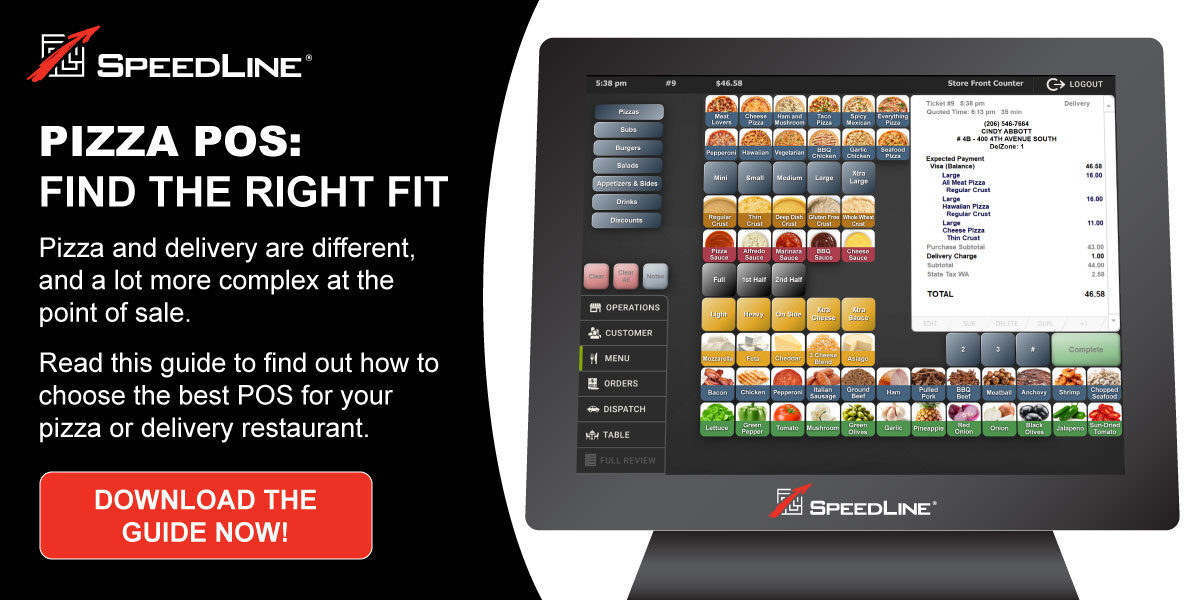
A pizza-specific POS and inventory approach can instead account for how ingredients are actually used across different menu configurations. SpeedLine's existing inventory material, for example, describes using topping matrices and pizza-specific calculations to track ingredient usage for create-your-own and half-and-half pizzas.
That distinction matters because accurate inventory information depends on accurately understanding what was sold.
1. Connect Sales to Ingredient Usage
One of the most useful capabilities of restaurant inventory management is connecting what the restaurant sells with what it uses.
When an order is entered into the POS, the system knows which menu items were sold.
If those menu items are connected to recipes and ingredients, sales information can be used to estimate the ingredients consumed.
For example, selling a pepperoni pizza should affect the expected usage of:
- Dough
- Sauce
- Cheese
- Pepperoni
Selling a pizza with additional toppings should affect ingredient usage accordingly.
This creates a connection between the sales side of the business and the inventory side.
Instead of looking at inventory as a completely separate process, operators can use sales information to understand expected ingredient consumption.
2. Use Recipe Costing to Understand Food Costs
Knowing what an ingredient costs is useful.
Knowing what an entire menu item costs to produce is even more useful.
Recipe costing allows operators to calculate the ingredient cost associated with a menu item.
For a pizza, that may include the cost of:
- Dough
- Sauce
- Cheese
- Toppings
- Specialty ingredients
- Other recipe components
Recipe costing can help operators understand how ingredient costs affect the overall economics of the menu.
It can also provide useful information when evaluating menu prices.
Ingredient prices can change over time. Cheese, meat, vegetables, and other products may cost more or less than they did when a menu item was originally priced.
If operators don't have visibility into current ingredient costs, they may not realize how those changes are affecting food cost.
3. Track Food Cost More Accurately
Food cost is one of the most important financial measurements for a restaurant.
At a basic level, operators can compare the cost of food used with sales to understand their food cost percentage.
But the challenge is determining how much food should have been used based on what the restaurant actually sold.
That is where detailed inventory, and recipe information can help.
A pizza-specific system can account for different sizes, toppings, modifiers, and other menu variations when calculating expected ingredient usage.
This can provide operators with a more useful picture of food costs than simply looking at total purchasing expenses.
SpeedLine has also published material describing how inventory data and recipes can be used alongside sales information to analyze food costs and product margins.
4. Control Portion Sizes
Portion control has a direct relationship with inventory.
If employees consistently use more cheese, sauce, meat, or toppings than a recipe calls for, ingredient usage can exceed expectations.
That additional usage may not be obvious on an individual order.
Across hundreds or thousands of orders, however, small differences can add up.
Consistent portioning can help restaurants:
- Maintain recipe consistency
- Reduce unnecessary ingredient usage
- Improve food cost control
- Make inventory usage more predictable
- Deliver a more consistent customer experience
Tools such as scales, scoops, and other portion-control equipment can help employees follow standardized preparation procedures.
Technology doesn't replace good operating procedures.
It can, however, give operators better visibility into whether those procedures are producing the expected results.
5. Reduce Food Waste
Not every inventory problem comes from selling too much food.
Waste can occur when ingredients:
- Spoil before they are used
- Are over-portioned
- Are prepared in excessive quantities
- Are damaged
- Are incorrectly stored
- Are discarded because of preparation mistakes
- Become obsolete after menu changes
Better inventory visibility can help operators identify areas where waste may be occurring.
For example, if an ingredient is consistently purchased in quantities that exceed actual usage, the restaurant may be carrying unnecessary inventory.
If another ingredient is regularly running short, purchasing quantities or menu demand may need to be examined.
Inventory management can therefore become part of a broader effort to reduce food waste and improve purchasing decisions.
6. Understand Actual Inventory vs. Expected Inventory
One of the most valuable comparisons an operator can make is between what should be in inventory and what is actually there.
Imagine that sales indicate a restaurant should have used a certain amount of cheese during a period.
The operator then counts the remaining cheese and discovers that actual inventory doesn't match the expected amount.
That difference can be a signal worth investigating.
Potential causes might include:
- Over-portioning
- Waste
- Spoilage
- Incorrect recipes
- Incorrect inventory counts
- Receiving discrepancies
- Theft or loss
- Data-entry errors
The point isn't to assume there is a problem every time numbers don't match.
The point is that the difference gives the operator something to investigate.
Without inventory visibility, those differences can be difficult to identify.
7. Make Purchasing Decisions With Better Information
Inventory management also affects purchasing.
Operators need enough ingredients to meet demand without tying up too much unnecessary money in excess inventory.
Buying too little can create shortages.
Buying too much can increase storage requirements, spoilage risk, and the amount of cash unnecessarily tied up in inventory.
Historical sales information can help operators understand demand patterns and make more informed purchasing decisions.
When sales, recipes, inventory, and purchasing information are connected, operators have more context for deciding what needs to be ordered and when.
8. Keep Inventory Information Connected to the POS
A pizza POS is already responsible for recording what the restaurant sells. That makes the connection between POS and inventory particularly important. For a broader look at the capabilities operators should consider, see our guide to pizza POS features.
A disconnected inventory process may require operators or employees to move information between systems manually.
An integrated approach can allow sales information to contribute directly to inventory calculations.
That connection can help create a workflow such as:
Customer Order → Pizza POS → Recipe/Ingredient Usage → Inventory → Food Cost Reporting
This is one reason inventory should be considered when evaluating a pizza POS.
The question isn't simply whether the system can process an order.
Operators should also consider what happens to the information after the sale.
9. Look for Pizza-Specific Inventory Capabilities
Not every restaurant inventory system is designed for the complexity of pizza.
When evaluating inventory software for a pizzeria, operators should consider whether the system can handle:
- Create-your-own pizzas
- Half-and-half pizzas
- Multiple pizza sizes
- Topping quantities
- Modifiers
- Recipe ingredients
- Ingredient costs
- Recipe costing
- Food cost reporting
- Portion control
- Inventory counts
- Waste
- Purchasing
- Sales-based ingredient usage
Pizza-specific functionality can be particularly important when a restaurant has a highly customizable menu.
The more complex the menu becomes, the more important it is for inventory calculations to reflect how customers actually order.
10. Don't Forget Menu Changes
Restaurant menus aren't static.
Operators may:
- Add new pizzas
- Remove underperforming items
- Change recipes
- Introduce limited time offers
- Change topping options
- Adjust portion sizes
- Change prices
- Substitute ingredients
Every one of these changes can potentially affect food costs.
That's why inventory information should be maintained alongside menu and recipe information.
A change to a recipe can change the cost of the item.
A change to ingredient pricing can change food cost.
A change to the selling price can change the food cost percentage.
Operators need visibility into those relationships when making menu decisions.
11. Use Inventory Data to Support Menu Decisions
Inventory management isn't only about reducing costs.
It can also help operators make better decisions about the menu.
Suppose a pizzeria is considering introducing a new specialty pizza.
Before adding it permanently, the operator may want to understand:
- What ingredients are required?
- What will each pizza cost to produce?
- What selling price makes sense?
- Which existing ingredients can be used?
- Will the new item create additional inventory requirements?
- How might it affect overall food cost?
The same information can be useful when evaluating price changes.
SpeedLine's Sales Mix tools, for example, have historically been used to model menu pricing and analyze food costs using inventory costs and recipes.
The broader principle is simple: inventory information can support decisions, not just recordkeeping.
12. Make Inventory Part of the Larger Pizza POS Workflow
Inventory shouldn't exist in isolation.
Modern pizzerias often operate across several connected systems and workflows:
Online Ordering → POS → Kitchen → Pickup or Delivery → Sales Reporting → Inventory
An order that begins with pizza online ordering on a restaurant website or another ordering channel can ultimately affect kitchen production, delivery operations, customer information, sales reporting, and ingredient usage.
For restaurants handling their own deliveries, a pizza delivery POS can connect ordering and delivery information with the rest of the restaurant's workflow. Pizza dispatch software can extend that workflow into driver assignment, routing, and delivery management.
That makes integration increasingly important.
SpeedLine's recent pizza POS and online-ordering content describes this connected approach, where online orders can move into the POS and then into kitchen, pickup, or delivery workflows.
Inventory is another part of that operational picture.
The more connected the systems are, the less operators need to rely on manual data transfer between separate processes.
What Should Pizzerias Look for in Inventory Software?
When comparing inventory solutions, restaurant operators should look beyond a basic inventory-counting feature.
Consider asking:
Does it understand pizza recipes?
The system should be able to handle the way pizzas are actually built, including sizes, toppings, modifiers, and custom orders.
Does it connect with the POS?
Sales information should be able to contribute to ingredient usage and inventory reporting.
Can it calculate recipe costs?
Operators should be able to understand what menu items cost based on their ingredients.
Can it help identify food cost changes?
Ingredient prices change. The system should make it easier to understand how those changes affect menu costs.
Can it support portion control?
Standardized recipes and portion information can help employees consistently prepare menu items.
Can operators compare expected and actual inventory?
This can help identify waste, over-portioning, receiving issues, or other discrepancies.
Can it support growing operations?
A system that works for one location may need to support additional locations, more menu items, or more complex reporting as the business grows.
Inventory Management Is About More Than Counting Ingredients
For a pizzeria, inventory management is ultimately about understanding the relationship between what you buy, what you sell, and what you use.
The challenge is that pizza menus can make that relationship complicated.
A customer may order a pizza with multiple toppings, different quantities, special instructions, or a half-and-half configuration. The restaurant still needs to understand what ingredients were used and what that order contributed to food costs.
That is why pizza-specific inventory management can be valuable.
When inventory, recipes, sales, and the POS work together, operators can gain greater visibility into food costs and ingredient usage while reducing the amount of manual work involved in managing the business.
How SpeedLine Can Support Pizza Restaurant Inventory Management
SpeedLine is designed around the operational requirements of pizza restaurants and delivery-focused businesses.
For operators evaluating a connected pizza technology environment, inventory is one piece of a larger system that can include POS, online ordering, kitchen operations, delivery management, reporting, and customer information.
SpeedLine's pizza POS capabilities are designed to handle the complex menu structures common in pizzerias, while connected technology can help operators manage the flow of information throughout the restaurant.
For a pizzeria looking to gain more visibility into food costs, ingredient usage, and restaurant operations, inventory management is an important part of the technology conversation.
The Bottom Line
Pizza restaurant inventory management isn't simply about counting boxes, weighing ingredients, or checking what is in the walk-in.
It's about understanding the relationship between sales, recipes, ingredients, costs, waste, and overall profitability.
For pizzerias, that requires inventory technology capable of handling the complexity of pizza menus.
When operators can connect POS sales with recipes, ingredient usage, food costs, and inventory information, they have a clearer view of what is happening inside the business.
And that visibility can help them make more informed decisions about purchasing, portions, menu pricing, waste, and day-to-day operations.
Looking for a pizza POS that can connect more of your restaurant's operations?
Request a Call to learn how SpeedLine can help connect POS, online ordering, delivery, kitchen operations, reporting, and inventory management for your pizzeria.
Related Articles
What Is a Pizza POS? The Definitive Information Guide for Operators
Pizza POS Features: What Should a Pizza Restaurant POS Include?
Pizza Online Ordering: The Complete Guide for Pizzerias
Pizza Delivery POS: The Complete Guide for Delivery Restaurants
Pizza Dispatch Software: What Restaurants Need to Know
Restaurant Profitability: 6 Keys to Food Cost Control for Pizzerias
Manage Your Inventory Right to Save on Your Bottom Line
Reviewing Prices Using the SpeedLine Sales Mix for Price Modeling and Cost Analysis
Posted on Wed, Sep 30, 2026 @ 12:09 PM.
Updated on September 30, 2026 @ 9:12 PM PST.