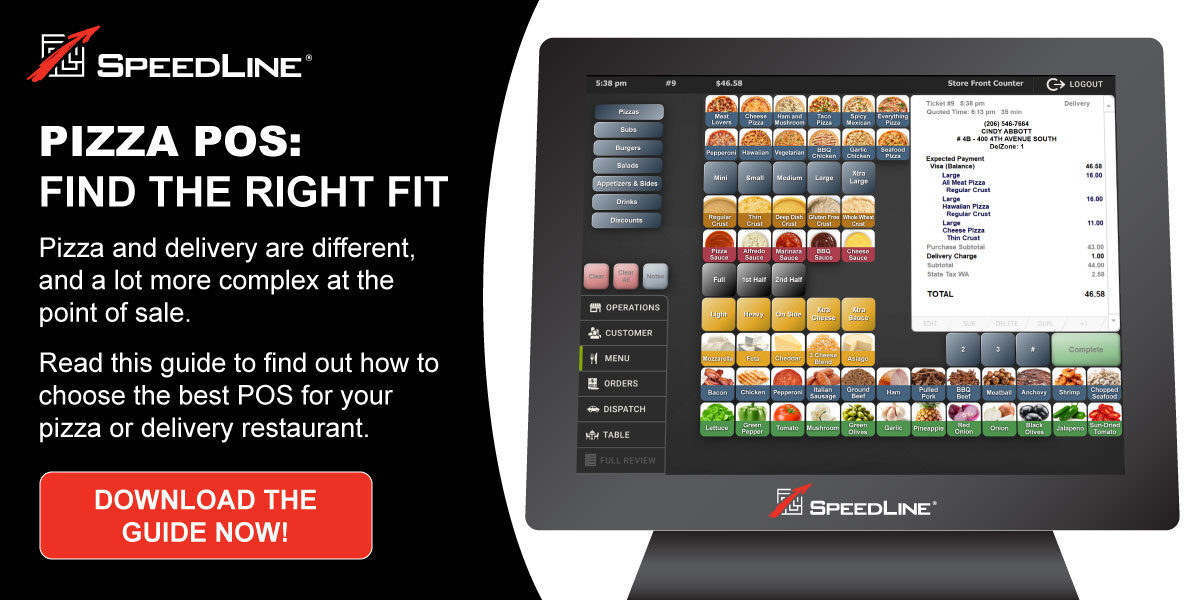


Everything Pizza Restaurant Operators Need to Know About Choosing a POS for Delivery, Dispatch, Online Ordering, and More
Pizza delivery is different.
A busy pizzeria isn't simply taking orders and processing payments. At any given moment, the team may be managing phone orders, online orders, walk-in customers, complex pizza customizations, delivery zones, drivers, promotions, kitchen production, and customers waiting for their food.
On a busy Friday night, all of those moving parts need to work together.
That's why choosing a point-of-sale system for a pizza delivery operation is about much more than selecting a payment terminal.
The right pizza delivery POS can help connect the entire operation, from the moment a customer places an order to the moment that order arrives at their door.
In this guide, we'll explain what a pizza delivery POS is, why delivery-focused pizzerias have different technology needs, and what features restaurant operators should look for when evaluating a POS system, like delivery management, driver tracking, routing, and online ordering.
What Is a Pizza Delivery POS?
A pizza delivery POS is a point-of-sale system designed to support the operational needs of pizza restaurants that offer delivery.
A traditional restaurant POS may focus primarily on taking orders and processing payments. A pizza delivery POS, however, may need to support a much larger workflow.
A typical delivery order can move through several stages:
Order → Kitchen → Make Line → Oven → Dispatch → Driver → Customer
At every stage, accurate information matters.
The restaurant needs to know:
- What the customer ordered
- How the pizza should be customized
- Where the order is going
- Whether the address is inside the delivery area
- When the order should be prepared
- When it is ready
- Which driver will take it
- Whether it has been delivered
For a busy pizza restaurant, managing those steps across multiple disconnected systems can create unnecessary complexity.
A pizza delivery POS helps bring those workflows together so the restaurant can manage orders from one stage to the next with greater visibility and consistency.
A delivery POS is also part of the broader technology environment used by modern pizzerias. For a deeper look at the overall category, read our guide on what a pizza POS is and how it supports pizza restaurant operations.
Why Pizza Delivery Restaurants Have Different POS Needs
A general restaurant POS can be a good fit for many businesses.
But pizza delivery restaurants often have operational requirements that go beyond traditional restaurant service.
Consider a busy evening.
Orders may arrive simultaneously through:
- Phone calls
- Online ordering
- Mobile ordering
- Walk-in customers
- Multiple restaurant locations
- Third-party ordering platforms
At the same time, employees may be managing dozens of active orders at different stages of production and delivery.
The restaurant needs answers to questions such as:
- Has this order been made?
- Is it waiting for the oven?
- Is it ready for dispatch?
- Which driver should take it?
- Has it left the restaurant?
- Is another delivery heading in the same direction?
When employees have to switch between disconnected systems or manually transfer order information, the opportunity for mistakes increases.
For delivery-focused pizzerias, the POS can become the operational hub connecting order entry, production, customer information, dispatch, and delivery.
10 Features to Look for in a Pizza Delivery POS
Not every POS system is designed for the same type of restaurant.
When evaluating technology for a pizza delivery operation, restaurant owners should look beyond basic payment processing.
Here are 10 features worth considering.
1. Pizza-Specific Order Customization
Pizza orders can be complicated.
Customers may choose from multiple:
- Pizza sizes
- Crust options
- Sauces
- Toppings
- Extra toppings
- Half-and-half combinations
- Cooking instructions
- Specialty pizzas
- Combos and meal deals
The POS should make those choices easy to enter accurately.
For example, an employee should be able to quickly enter an order for a large pizza with different toppings on each half without creating confusion for the kitchen.
Pizza-specific ordering tools can organize modifiers and menu options around the way pizza restaurants actually take orders.
This can make order entry faster and help ensure that detailed instructions follow the order throughout the production process.
2. Delivery Zone Management
Delivery zones are an important part of many pizza delivery operations.
Restaurants need to know whether an address is eligible for delivery and, depending on the operation, whether different delivery fees or rules apply.
A delivery-focused POS can help restaurants manage their service areas more efficiently.
For example, the restaurant may need to determine:
- Does the restaurant deliver to this address?
- Which delivery zone is the customer located in?
- Does a delivery fee apply?
- Are there special delivery rules for this area?
During busy periods, employees should not have to spend unnecessary time manually checking maps or trying to determine whether an address falls inside the delivery area.
The more efficiently this information can be handled during order entry, the easier it can be to keep the delivery process moving.
3. Driver Dispatch and Management
Getting an order out of the kitchen is not the end of the process.
For delivery restaurants, the next challenge is getting that order to the customer efficiently.
A pizza delivery POS should support the workflow involved in dispatching drivers and managing active deliveries.
Depending on the operation, useful capabilities may include:
- Assigning orders to drivers
- Viewing orders waiting for delivery
- Managing multiple deliveries
- Tracking delivery status
- Organizing driver activity
- Managing driver cash and payment reconciliation
Dispatch becomes especially important during high-volume periods.
If orders are assigned inefficiently, restaurants may experience longer delivery times, unnecessary driving, and frustrated customers.
Clear visibility into active deliveries can help managers make faster operational decisions.
4. Integrated Online Ordering
Online ordering has become an important sales channel for many pizza restaurants.
But the way online orders connect with the restaurant's POS can make a significant difference.
If employees have to manually re-enter online orders into another system, the restaurant may experience added delays and errors:
- More labour
- Duplicate work
- Order-entry errors
- Delays during busy periods
Integrated online ordering allows order information to move directly into the restaurant's operational workflow.
That connected workflow can also provide valuable information for inventory management, helping operators connect sales activity with ingredient usage and food costs.
Learn more about pizza restaurant inventory management.
That means employees can spend less time transferring information and more time preparing and delivering orders.
When evaluating a pizza delivery POS, restaurants should consider how online ordering connects with core delivery workflows and real‑time operations :
- The restaurant's menu
- Pricing
- Promotions
- Kitchen operations
- Customer information
- Reporting
A connected workflow can help simplify operations and create a more consistent experience from the customer's order through fulfillment.
5. Customer Information and Order History
Pizza delivery is often a repeat-purchase business.
Many customers order from the same restaurant regularly. Some may even order the same items each time.
A POS that helps maintain customer information and order history can make the ordering process more convenient.
Useful information may include:
- Customer contact details
- Delivery addresses
- Previous orders
- Frequently ordered items
For employees, access to this information can help speed up repeat orders.
For customers, it can create a more convenient ordering experience.
Customer data can also provide restaurant operators with a better understanding of purchasing patterns and customer behavior over time.
6. Coupons, Deals and Promotions
Promotions are an important part of many pizza restaurant marketing strategies.
Common offers include:
- Family meal deals
- Pizza-and-drink combinations
- Limited-time offers
- Coupons
- Discounts
- Loyalty promotions
The challenge is making those promotions easy for employees and customers to understand.
A POS should help restaurants manage promotional pricing without creating unnecessary confusion at the point of order.
When promotions are difficult to apply or require manual adjustments, they can slow down employees and increase the possibility of pricing mistakes.
The right system should support the restaurant's marketing strategy while maintaining accurate order information and reporting.
7. Kitchen and Production Management
Taking an order accurately is only the beginning.
The restaurant still needs to prepare the food efficiently.
A pizza order may move through several stages:
Order Entry → Make Line → Oven → Finishing → Dispatch
During a busy period, dozens of orders may be moving through those stages at once.
Employees need clear information about:
- What should be made
- How it should be customized
- When the order was placed
- Where the order is in the production process
Clear communication between order entry and production can help reduce mistakes and keep operations moving.
A connected POS workflow can help ensure that the same order information follows the pizza from the moment the customer places the order until it is ready for delivery.
8. Multi-Channel Order Management
Modern pizza restaurants may receive orders from multiple sources.
These may include:
- Phone
- Website
- Mobile ordering
- Walk-in customers
- In-store ordering
- Third-party ordering platforms
Managing each channel separately can make operations more complicated.
Employees may have to switch between screens, re-enter orders, or manually monitor multiple systems, causing extra delays and mistakes.
A connected approach to order management can help create greater visibility.
The goal is to make sure order information is available where it is needed without requiring employees to constantly transfer information between systems.
For high-volume restaurants, a more unified workflow can simplify training and help reduce the risk of orders being missed.
9. Reporting and Restaurant Analytics
A POS should help restaurant operators understand what is happening in their business.
Useful reporting may include:
- Daily sales
- Weekly sales
- Delivery sales
- Popular menu items
- Peak ordering periods
- Promotion performance
- Sales trends
- Location performance
This information can help operators make more informed decisions.
For example, if a restaurant consistently experiences its highest delivery volume during a particular period, managers may be able to adjust staffing and driver schedules accordingly.
Reporting can also help restaurants identify which menu items and promotions are performing well.
The right tools can turn daily transaction information into useful insights for managing the business.
10. Multi-Location Management
As pizza businesses grow, managing multiple locations can create additional challenges.
Owners may need visibility into:
- Sales across locations
- Menu consistency
- Pricing
- Promotions
- Operational performance
- Customer trends
A POS that supports multi-location operations can help restaurant groups maintain greater consistency while giving individual locations the tools they need to manage day-to-day operations.
For growing pizza brands, it is important to consider whether a POS can support the business today and continue supporting it as new locations are added.
Pizza Delivery POS vs. a General Restaurant POS
Not every pizza restaurant needs the same technology.
A general restaurant POS may be a good choice for some businesses, particularly those focused primarily on dine-in service.
However, delivery-focused pizza restaurants often have specialized requirements.
|
Feature |
General Restaurant POS |
Pizza Delivery POS |
|
Table management |
Often a major feature |
May be less important |
|
Pizza-specific modifiers |
Varies |
Core consideration |
|
Half-and-half toppings |
May vary |
Often important |
|
Delivery zones |
May require additional tools |
Important functionality |
|
Driver dispatch |
May be limited |
Important functionality |
|
Delivery workflow |
May be an add-on |
Central operational requirement |
|
Pizza promotions |
General capabilities |
Can support pizza-specific offers |
|
High-volume delivery management |
Varies |
Designed around delivery workflows |
The best choice depends on how the restaurant operates.
A small dine-in restaurant that serves pizza may have very different technology needs from a pizzeria that delivers hundreds of orders each week.
The more important delivery is to the business, the more closely operators should evaluate how well a POS supports the complete delivery workflow.
Who Needs a Pizza Delivery POS?
Independent Pizzerias
Independent pizza restaurants often need technology that helps employees work efficiently without adding unnecessary complexity.
Important considerations may include:
- Ease of use
- Accurate order entry
- Online ordering
- Delivery management
- Customer information
- Reporting
For a small team, reducing manual work can make a meaningful difference during busy periods.
High-Volume Delivery Restaurants
High-volume restaurants face additional pressure when orders begin arriving quickly.
These operations may need stronger tools for:
- Managing active orders
- Coordinating kitchen production
- Organizing dispatch
- Managing drivers
- Monitoring delivery activity
For these restaurants, the ability to clearly see and manage multiple orders at once can be an important part of maintaining efficient operations.
Multi-Location Pizza Brands
Multi-location businesses often need greater consistency across their restaurants.
Technology can help support standardized:
- Menus
- Pricing
- Promotions
- Reporting
- Operational processes
Centralized visibility can also help owners and managers compare performance across locations.
Hybrid Dine-In and Delivery Restaurants
Many pizza restaurants serve customers in several ways.
They may offer:
- Dine-in
- Pickup
- Delivery
- Online ordering
These restaurants need technology that can support different service models without forcing employees to manage completely disconnected systems.
The right POS should fit the restaurant's actual mix of business.
How to Choose the Right Pizza Delivery POS
Choosing a POS should start with understanding how the restaurant operates.
Before comparing systems, operators should ask several important questions.
How Complex Are Our Pizza Orders?
Restaurants with extensive customization should look for a system that makes complex orders easy to enter and communicate.
How Important Is Delivery to Our Business?
A delivery-heavy operation should closely evaluate features such as delivery zones, dispatch, driver management, and delivery workflow.
Where Do Our Orders Come From?
Restaurants should understand how phone, online, in-person, and other digital orders connect with the POS.
How Many Locations Do We Have?
Businesses planning to expand should consider whether the system can grow with them.
How Important Are Promotions?
Pizza restaurants that frequently use coupons and meal deals should evaluate how easily those promotions can be managed.
What Information Do We Need to Run the Business?
Reporting needs can vary significantly between a single independent pizzeria and a growing multi-location brand.
Does the Provider Understand Pizza Delivery?
This question is sometimes overlooked.
Pizza restaurants have unique operational challenges.
A technology provider that understands pizza and delivery workflows may be better positioned to support the specific requirements of a delivery-focused operation.
How SpeedLine Supports Pizza Delivery Operations
Pizza restaurants have workflows that are different from many other types of restaurants.
SpeedLine is designed specifically around pizza and delivery operations, with technology focused on the workflows involved in taking complex orders, managing customers, coordinating production, and organizing delivery.
For restaurants with significant delivery volume, the ability to connect different parts of the operation can be especially important.
From pizza-specific order entry to delivery management, online ordering, dispatch, and multi-location operations, the goal is to give restaurant teams greater visibility into what is happening throughout the order process.
The best POS is not simply the system with the longest feature list.
It is the system that best supports the way a restaurant actually operates.
When evaluating technology, pizza operators should consider how well each system fits the complete journey of an order, from the first customer interaction through production and delivery.
For restaurants looking to explore technology designed specifically for pizza and delivery operations, SpeedLine offers a range of solutions built around those workflows.
Frequently Asked Questions About Pizza Delivery POS
What Is a Pizza Delivery POS?
A pizza delivery POS is a point-of-sale system designed to help pizza restaurants manage orders, payments, delivery operations, customer information, and other day-to-day workflows.
Depending on the system, it may also support delivery zones, driver dispatch, online ordering, and pizza-specific order customization.
What Features Should a Pizza Delivery POS Have?
Important features may include:
- Pizza-specific order customization
- Delivery zone management
- Driver dispatch
- Online ordering integration
- Customer order history
- Promotions and coupons
- Kitchen workflow tools
- Reporting
- Multi-location support
The right combination depends on the restaurant's size and business model.
Can a Regular Restaurant POS Manage Pizza Delivery?
Some general restaurant POS systems can support delivery.
However, delivery-heavy pizza restaurants may have more specialized requirements involving complex pizza orders, delivery zones, driver management, and dispatch.
Restaurant operators should evaluate whether the system supports the complete workflow they need to manage.
What Is the Best POS System for Pizza Delivery?
The best POS system depends on factors such as:
- Delivery volume
- Order complexity
- Number of locations
- Online ordering requirements
- Driver management needs
Restaurants with significant delivery operations should consider systems designed specifically around pizza and delivery workflows.
How Does a Pizza Delivery POS Help Reduce Order Errors?
A connected POS can help reduce manual data entry and ensure that order information moves consistently through the restaurant.
Clear modifiers, organized order entry, integrated online ordering, and connected production workflows can all help reduce opportunities for mistakes.
Does a Pizza Delivery POS Work With Online Ordering?
Many modern pizza POS systems support online ordering.
The important question is how well online orders connect with the restaurant's menu, pricing, promotions, production workflow, and overall POS system.
A connected approach can reduce manual work and help ensure orders move efficiently through the restaurant, improving overall flow .
The Bottom Line
A pizza delivery POS is about more than processing payments.
For a delivery-focused pizza restaurant, it can become an important part of the entire operation.
The right system can help manage:
- Orders
- Complex pizza customizations
- Customer information
- Online ordering
- Kitchen production
- Delivery zones
- Driver dispatch
- Reporting
The best solution will depend on the individual restaurant.
However, businesses with significant delivery volume should carefully evaluate whether their technology supports the complete operational workflow.
A system designed around pizza and delivery can help reduce manual work, improve visibility, and support a more efficient order-to-delivery process.
When evaluating a POS, consider every stage of the customer journey:
Order → Kitchen → Make Line → Oven → Dispatch → Driver → Customer
The closer the technology aligns with the way the restaurant actually operates, the more value it can potentially provide.
Looking for a POS Built for Pizza Delivery?
SpeedLine is designed around the workflows of pizza and delivery restaurants, from complex order entry and online ordering to delivery zones, dispatch, and driver management.
Explore how SpeedLine can support your pizza delivery operation.
Request a phone call with a SpeedLine expert
Looking to expand beyond traditional delivery workflows? See how operators are boosting midweek volume and streamlining catering operations with our newest integration update. Read the full ezCater Marketplace announcement here: