

How Online Ordering Works, What Features Matter, and How Digital Orders Connect to Your Pizza POS
For today's pizzerias, online ordering is more than a convenient way for customers to place an order. It has become an important part of how pizza restaurants manage sales, customer relationships, kitchen production, delivery, and day-to-day operations.
Customers expect to be able to order from a website or mobile device, customize their pizzas, apply promotions, choose pickup or delivery, and receive accurate information about their order. At the same time, restaurant operators need those digital orders to move efficiently from the customer to the kitchen and, when necessary, to the delivery driver.
That's where a pizza online ordering system connected to a pizza POS can make a difference.
Instead of treating online orders as a separate channel, an integrated system can connect digital ordering with the same restaurant operations used to manage phone orders, in-store orders, kitchen production, delivery, reporting, and customer information.
This guide explains what pizza online ordering is, how it works, what aggregator sync means, which features matter most, and what pizzeria operators should consider when choosing the right digital ordering solution for their restaurant.
What Is Pizza Online Ordering?
Pizza online ordering allows customers to place orders digitally through a restaurant's website, online ordering page, mobile experience, or connected ordering platform.
Depending on the system, customers may be able to:
- Browse the restaurant's menu
- Build custom pizzas
- Select sizes, crusts, toppings, and specialty options
- Create half-and-half pizzas
- Add sides, drinks, desserts, and other menu items
- Apply coupons or promotions
- Choose pickup or delivery
- Select a preferred pickup or delivery time
- Enter payment information
- Save ordering information for future purchases
For the restaurant, the goal is to receive that order accurately and efficiently without requiring employees to manually re-enter information from a website, app, or third-party ordering channel.
That connection becomes particularly important during busy periods.
Why Online Ordering Matters for Pizzerias
Pizza restaurants have some of the most customizable menus in the restaurant industry.
A single order might include multiple pizzas with different sizes, crusts, toppings, sauces, substitutions, special instructions, sides, discounts, and delivery requirements.
When digital ordering is disconnected from the restaurant's POS, employees may have to manually transfer information into another system. That creates additional work and introduces opportunities for mistakes.
An integrated pizza online ordering system can help connect the customer's digital order directly with the restaurant's POS and operational workflow.
The result can be a more consistent process:
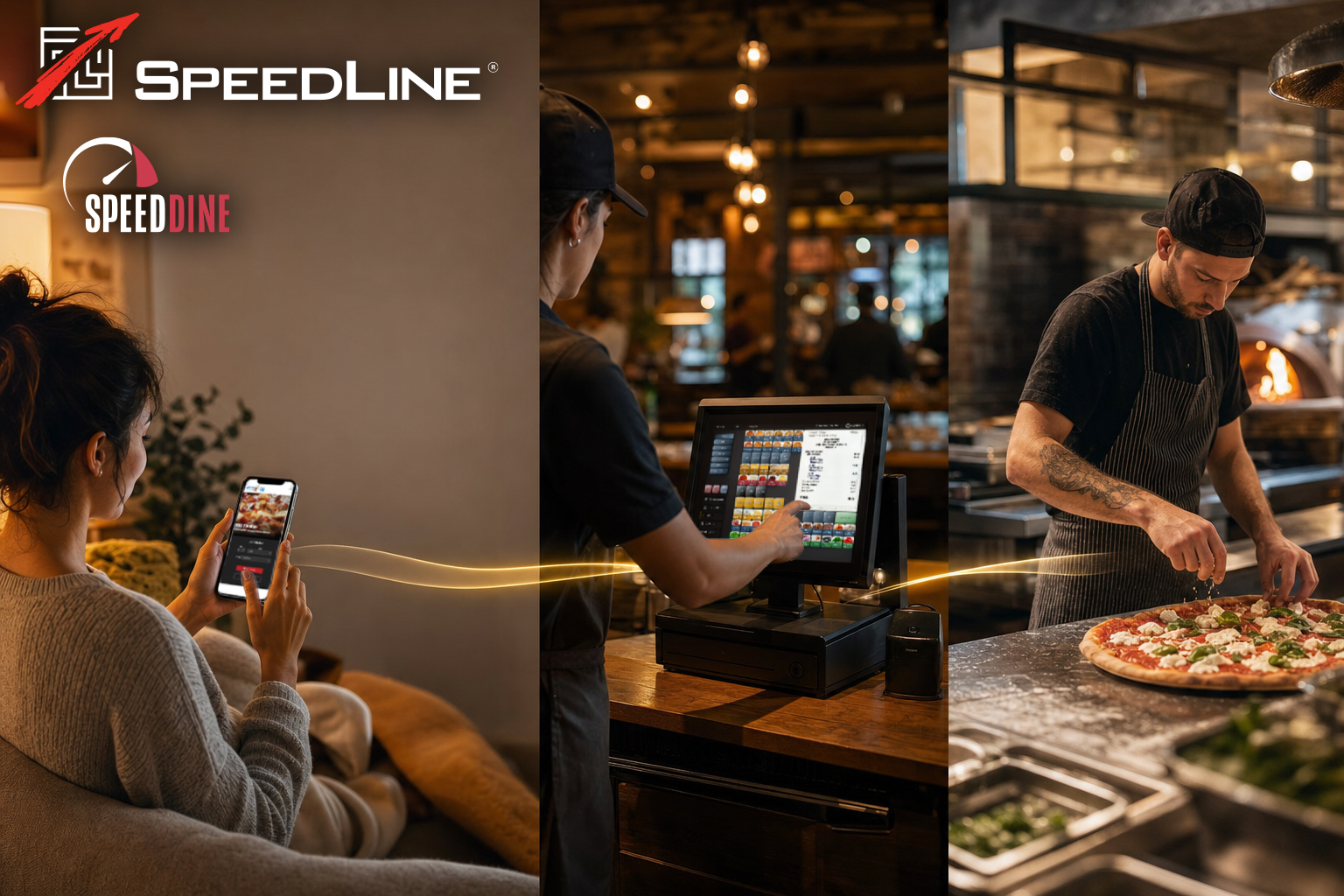
Customer → Online Order → Pizza POS → Kitchen → Pickup or Delivery → Customer
That workflow becomes even more important as a restaurant adds more ordering channels.
10 Features to Look for in a Pizza Online Ordering System
Not every online ordering platform is designed specifically for pizza. When evaluating a solution, restaurant operators should consider how well it handles the complexity of a pizzeria's menu and how effectively it connects with the rest of the restaurant.
1. Pizza-Specific Menu Customization
Pizza ordering can be considerably more complicated than selecting an entrée from a traditional restaurant menu.
Customers may want to customize:
- Pizza size
- Crust
- Sauce
- Cheese
- Toppings
- Extra toppings
- Specialty pizzas
- Half-and-half combinations
- Multiple quantities
- Special instructions
A pizza-focused online ordering system should make those choices easy for customers while translating them accurately into the restaurant's POS and kitchen workflow.
The goal is to give customers flexibility without creating confusion for employees.
2. Direct POS Integration
One of the most important considerations is how online orders connect to the restaurant's point-of-sale system.
With an integrated system, an online order can move into the POS without requiring an employee to manually re-enter every item.
That can help reduce duplicate data entry and create a more consistent order record.
It also allows the POS to remain a central source of information for orders, menus, pricing, promotions, reporting, and restaurant operations.
For operators evaluating systems, it's worth asking:
Does the online ordering system actually integrate with the POS, or does it simply send orders to the restaurant?
Those are two very different approaches.
3. Accurate Menu and Pricing Management
Online menus need to reflect what the restaurant actually sells.
When prices, toppings, availability, promotions, or menu items change, operators don't want to maintain multiple disconnected menus manually.
A connected digital ordering environment can make it easier to maintain consistency across multiple ordering channels while helping keep menus, pricing, and order information aligned across the restaurant’s digital ordering ecosystem.
This becomes particularly important for restaurants operating multiple locations.
4. Pickup and Delivery Options
Customers should be able to choose how they want to receive their order.
Depending on the restaurant, options may include:
- Pickup
- Curbside pickup
- Delivery
- Scheduled ordering
- Different delivery areas
For delivery restaurants, online ordering should work together with the restaurant's delivery management process.
That means the order should be able to move from the online ordering channel into the restaurant's normal delivery workflow.
For more information about the technology behind delivery operations, see our guide to Pizza Delivery POS: The Complete Guide for Delivery Restaurants.
5. Delivery Zones and Fees
Delivery isn't the same for every customer.
Restaurants may have different delivery zones, minimum order requirements, delivery fees, and estimated delivery times.
An online ordering system should be able to work with the restaurant's delivery rules rather than treating every address the same.
This can help customers receive appropriate delivery information before they complete their order.
It can also help operators maintain greater control over where and how they deliver.
6. Coupons and Promotions
Promotions are an important part of pizza restaurant marketing.
Pizzerias may offer:
- Percentage discounts
- Dollar-off promotions
- Combo deals
- Buy-one-get-one offers
- Free items
- Delivery promotions
- Customer-specific offers
- Limited-time specials
Online ordering should be able to apply promotions accurately and consistently with the restaurant's POS.
For customers, the process should be simple.
For operators, the promotion should be reflected correctly in the order and reporting.
7. Multiple Ordering Channels
Online ordering is only one part of the modern restaurant ordering environment.
A pizzeria may receive orders through:
- Its website
- Online ordering
- Phone orders
- In-store orders
- Mobile ordering
- Third-party marketplaces
- Catering platforms
Managing each channel separately can create additional complexity.
A connected restaurant technology ecosystem can bring more of those orders into the same operational environment.
This is one of the reasons integrations such as SpeedLine Marketplace can be valuable for restaurants that use multiple third-party ordering channels.
For more detailed information, see our article on Expanding Your Digital Ordering Power: ezCater Now in Marketplace.
What Is Aggregator Sync?
Aggregator Sync is the process of connecting third-party online ordering platforms and marketplaces with a restaurant's point-of-sale system so that orders and, depending on the integration, menu information can move between systems more efficiently.
For a pizza restaurant, this can be particularly important because customers may place orders through several different channels. A pizzeria could receive orders through its own website as well as third-party platforms such as DoorDash, Uber Eats, Grubhub, or other catering and online ordering marketplaces.
Without an integrated approach, employees may need to monitor multiple platforms and manually enter orders into the restaurant's POS. That can add work and create opportunities for errors.
With aggregator sync, supported ordering channels can be connected to the restaurant's POS environment. Orders can flow directly into the POS with the relevant information needed for accurate processing, while integrations may also help keep menu information, pricing, and order details more consistent across supported channels.
For restaurant operators, potential benefits include:
- Less manual order entry — Orders from supported channels can flow into the POS instead of being re-entered by employees
- More consistent menu information — Menu items, prices, and modifiers can be managed more efficiently across connected channels, depending on the integration
- Improved order accuracy — Reducing manual transcription can help minimize mistakes when transferring orders
- A more connected kitchen workflow — Digital orders can enter the same POS and kitchen processes used for other restaurant orders
- Centralized operations — Operators can manage more ordering activity through their restaurant technology ecosystem
- Better visibility — Bringing orders into the POS can make it easier to include digital sales in restaurant reporting
Aggregator Sync vs. Online Ordering
The terms are related, but they describe different parts of the digital ordering process.
Online ordering is the customer-facing process that allows someone to place an order digitally.
Aggregator sync describes the technology connection that can bring orders from supported third-party ordering channels into the restaurant's POS.
In simple terms:
Customer → Ordering Platform → Aggregator Sync → Pizza POS → Kitchen → Pickup or Delivery
For a pizzeria using multiple digital ordering channels, this connection can be an important part of managing online orders efficiently.
Why Aggregator Sync Matters for Pizza Restaurants
Pizza restaurants often have highly customized menus, which makes accurate order transmission especially important.
An order might include several pizzas with different sizes, crusts, toppings, modifications, sides, beverages, promotions, and delivery information.
When that information has to be manually transferred from one ordering platform into another system, every additional step creates another opportunity for an error.
A properly configured integration can help reduce those manual steps while allowing the restaurant to maintain its normal POS and kitchen workflow.
This is one reason operators should look beyond whether an online ordering provider simply accepts orders. They should also ask how those orders get into the restaurant's POS and what information is synchronized between systems.
Aggregator Sync and SpeedLine Marketplace
SpeedLine Marketplace is designed to connect supported third-party ordering channels with the SpeedLine environment.
For pizza restaurants using multiple digital ordering sources, this can help bring third-party orders into the same POS workflow used to manage restaurant operations.
The result is a more connected approach to digital ordering:
Online Ordering + Third-Party Ordering + POS + Kitchen + Delivery
For more information about how SpeedLine Marketplace is expanding its digital ordering capabilities, see Expanding Your Digital Ordering Power: ezCater Now in Marketplace.
8. Kitchen Integration
Getting an online order is only the beginning.
The restaurant still needs to make it.
A digital order should move efficiently into kitchen production with the information employees need to prepare it correctly.
That can include:
- Pizza size
- Crust
- Toppings
- Modifications
- Special instructions
- Sides
- Beverages
- Timing information
- Pickup or delivery details
When online ordering and the POS are connected to kitchen operations, employees can work from the same order information instead of relying on manual transcription.
Learn more about pizza restaurant inventory management and how pizzerias can connect sales activity with inventory, recipes, and food costs
9. Customer Information and Order History
Digital ordering can also provide useful customer information.
Depending on the system and the restaurant's practices, operators may be able to access information such as:
- Previous orders
- Favorite items
- Order frequency
- Customer contact information
- Delivery information
- Promotion usage
This information can help restaurants better understand customer behavior, identify ordering trends, and create more relevant offers and promotions.
It can also make repeat ordering easier for customers.
10. Reporting and Analytics
Online ordering should contribute to the restaurant's overall understanding of its business.
Operators may want to know:
- How many orders are coming from online channels
- Which menu items are selling
- Which promotions are being used
- Pickup versus delivery volume
- Sales by location
- Sales by ordering channel
- Customer ordering trends
The more disconnected the ordering systems are, the more difficult it can be to get a complete picture of restaurant performance, customer activity, and overall digital ordering trends.
An integrated POS and online ordering environment can help bring that information together.
Pizza Online Ordering vs. Third-Party Ordering
It's important to distinguish between online ordering and third-party ordering.
A restaurant's own online ordering system allows customers to order directly through the restaurant's digital presence.
Third-party platforms provide another way for customers to discover and order from restaurants.
Both can be valuable, but they create different considerations for restaurant operators.
|
Consideration |
Restaurant Online Ordering |
Third-Party Ordering |
|
Customer relationship |
Direct relationship with restaurant |
Often managed through platform |
|
Branding |
Restaurant-controlled |
Platform-controlled |
|
Ordering channel |
Website or restaurant-owned experience |
Third-party marketplace |
|
Menu management |
Restaurant-controlled |
Depends on integration |
|
Fees |
Depends on provider |
Often includes platform-related costs |
|
Customer discovery |
Relies on restaurant marketing |
Can provide marketplace exposure |
|
POS integration |
Important |
Especially important |
|
Delivery |
Can connect to restaurant delivery |
May connect through platform or integration |
For many pizzerias, the question isn't necessarily whether to use one or the other.
The more important question may be how to manage multiple ordering channels without creating unnecessary operational complexity.
Why POS Integration Matters
Online ordering becomes much more powerful when it is connected to the restaurant's POS.
Consider what happens when a customer places a complicated pizza order.
The system needs to communicate:
What was ordered → How much it costs → What needs to be made → Where it needs to go → When it needs to be ready → How it will be delivered
If those pieces live in separate systems, employees may need to move information between them.
When the systems are integrated, more of the process can happen within a connected workflow.
This is especially important for delivery-focused pizzerias.
A pizza POS designed for these operations can connect online orders with kitchen production and delivery management.
For a broader look at what a pizza-focused POS should provide, see What Is a Pizza POS? The Definitive Information Guide for Operators.
How SpeedLine Supports Pizza Online Ordering
SpeedLine is designed specifically around the needs of pizza and delivery restaurants.
Its technology connects point-of-sale operations with online ordering, delivery management, kitchen workflow, reporting, and other restaurant functions.
SpeedLine PLUS provides tools for managing restaurant operations, including menu management, online ordering, and customer engagement.
SpeedLine Marketplace connects supported third-party ordering channels with the SpeedLine environment, helping restaurants bring orders from multiple sources into their POS workflow.
For delivery-focused restaurants, SpeedLine Delivery adds tools for managing delivery operations, including delivery zones, dispatch, routing, and driver management.
Together, these capabilities can help connect the digital ordering experience with what happens inside the restaurant.
The objective isn't simply to accept more online orders.
It's to make sure those orders can move efficiently through the entire operation.
What Should a Pizzeria Look for When Choosing Online Ordering Software?
Before choosing an online ordering system, restaurant operators should consider how it fits the entire business.
Here are some questions to ask:
Does it understand pizza?
Can customers easily build customized pizzas with complex combinations and modifications?
Does it integrate with your POS?
Can online orders flow directly into the POS without unnecessary manual entry?
Does it support your delivery operation?
Can the system work with delivery zones, fees, dispatch, and routing?
Can it support multiple ordering channels?
Can restaurant-owned online orders and third-party orders be managed within the same operational environment?
Can you manage menus efficiently?
Can menu changes, pricing, toppings, and availability be managed consistently?
Does it support your kitchen?
Will employees receive the information they need to make orders accurately?
Can it grow with your business?
Will the technology support additional locations, higher order volume, and new ordering channels?
These questions can help operators evaluate online ordering based on the restaurant's actual workflow rather than simply comparing feature lists.
Common Mistakes When Choosing a Pizza Online Ordering System
Choosing a system designed for generic restaurants
A basic online ordering system may work for a restaurant with a simple menu but become difficult to manage when customers need to customize pizzas.
Treating online ordering as a separate system
If online orders require extensive manual entry into the POS, the restaurant may not receive all the benefits of digital ordering.
Ignoring delivery operations
For delivery-heavy pizzerias, online ordering and delivery management are closely connected.
Overlooking third-party integrations
Restaurants may add additional ordering channels over time. It's worth considering how those channels will fit into the restaurant's technology ecosystem.
Focusing only on the customer-facing website
The customer experience matters, but so does what happens after the order is submitted.
A great ordering experience can still create operational challenges if the restaurant cannot efficiently receive, make, manage, and deliver the order.
The Future of Pizza Online Ordering
Digital ordering will continue to evolve as customers become more comfortable ordering food through websites, mobile devices, marketplaces, and other digital channels.
For pizzerias, the challenge isn't simply keeping up with new ordering technology.
It's making sure those channels work together.
As restaurants add online ordering, third-party marketplaces, loyalty programs, catering platforms, delivery services, and other digital tools, the POS increasingly becomes an important connection point between customer-facing technology and restaurant operations.
That's why restaurant operators should evaluate online ordering as part of the entire restaurant technology ecosystem, not as an isolated website feature.
Frequently Asked Questions About Pizza Online Ordering
What is a pizza online ordering system?
A pizza online ordering system allows customers to place and customize pizza orders digitally for pickup or delivery. Ideally, the system connects directly with the restaurant’s POS and operational workflow, helping ensure orders are processed accurately and efficiently from the moment they are placed through kitchen preparation and fulfillment.
Should online ordering integrate with a pizza POS?
For many pizzerias, POS integration can reduce manual order entry and help connect online orders with menus, pricing, kitchen production, reporting, and delivery operations.
Can pizza online ordering support custom pizzas?
A pizza-focused ordering system should support common pizza customizations such as sizes, crusts, toppings, sauces, substitutions, and half-and-half combinations.
What is aggregator sync?
Aggregator sync connects supported third-party ordering platforms with a restaurant’s POS so orders and, depending on the integration, menu information can move between systems more efficiently and with less manual entry.
Can online orders be used for delivery?
Yes. Online ordering can support delivery when it is connected to the restaurant's delivery workflow, including delivery zones, fees, dispatch, and driver management.
Can a pizza restaurant use both online ordering and third-party marketplaces?
Yes. Many restaurants use their own online ordering channel alongside third-party ordering platforms. The key consideration is how those channels integrate with the restaurant's POS and operational systems.
What is SpeedLine PLUS?
SpeedLine PLUS is part of the SpeedLine restaurant technology platform and provides tools designed to support pizza restaurant operations, including menu and ordering capabilities.
What is SpeedLine Delivery?
SpeedLine Delivery provides tools designed to help pizza and delivery restaurants manage delivery operations, including delivery zones, dispatch, routing, and driver management.
The Bottom Line
Online ordering has become an important part of modern pizza restaurant operations.
But the value of digital ordering goes beyond giving customers another way to place an order.
For a pizzeria, the real opportunity is connecting the entire process:
Customer → Online Ordering → Pizza POS → Kitchen → Pickup or Dispatch → Driver → Customer
The right pizza online ordering system should make that process easier for both customers and restaurant employees.
When evaluating solutions, look beyond the ordering page itself. Consider pizza-specific customization, POS integration, menu management, delivery, third-party ordering, aggregator sync, kitchen workflow, customer information, reporting, and the ability to support future growth.
For pizza restaurants using SpeedLine, SpeedLine PLUS, and SpeedLine Delivery, online ordering can become part of a connected technology ecosystem designed around the unique way pizzerias manage orders, kitchen operations, delivery, and customer interactions.
Looking for a POS and Online Ordering Solution Built for Pizza?
Learn how SpeedLine can help connect online ordering, point of sale, kitchen operations, delivery management, and more.
Posted on Wed, Sep 16, 2026 @ 15:09 PM.
Updated on September 30, 2026 @ 8:46 PM PST.